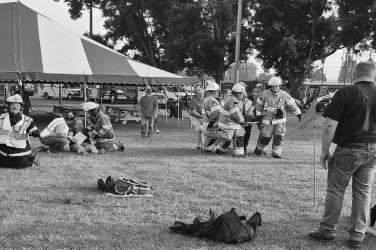
Mass casualty drills are one of the most important training tools we have to prepare for real emergencies. These exercises simulate high-impact events where responders must act quickly to save lives, manage chaos, and coordinate across agencies under stress. In such situations, training isn’t just helpful—it’s essential.
On August 11th , Murray County held a full-scale mass casualty exercise that brought together emergency responders from across the region. The simulated scenario involved a drunk driver recklessly entering the Murray County Fairgrounds during a major event. The vehicle struck multiple pedestrians and vehicles before crashing into a tree. The result: over two dozen simulated casualties with injuries ranging from minor to critical.
Mass Triage in Action
This drill focused heavily on mass triage—the process of quickly assessing and prioritizing patients based on the severity of their injuries. Responders used START triage (Simple Triage and Rapid Treatment) methods to categorize patients into: Immediate (red) – life-threatening injuries needing urgent transport Delayed (yellow) – serious but not immediately life-threatening Minor (green) – walking wounded Deceased/Expectant (black) – non-survivable or deceased In this scenario, first responders had to rapidly assess over 25 patients, many of whom were volunteers acting out realistic injuries with moulage (mock injury makeup). Patients were scattered across a chaotic scene, some trapped in vehicles, others wandering in shock, and a few critically injured.
Multi-Agency Response Under Stress The exercise tested every part of the emergency response system: Fire departments performed vehicle extrications, navigating crumpled metal and unstable vehicles to remove trapped patients.
EMS teams handled triage, treatment, and transport— quickly identifying who needed immediate evacuation and coordinating with hospitals for patient distribution.
Murray County Medical Center participated in surge protocol, accepting a flood of patients before reaching capacity and coordinating with other facilities to divert incoming ambulances.
Law enforcement and dispatch managed scene security, communication, and traffic control while tracking the movement of patients and resources. Air medical support from North Air Care was activated to simulate airlifting a critical patient.
Real-World Challenges Built In To make the exercise as realistic as possible, organizers included unplanned injects— new complications introduced during the drill. These included a injured firefighters, a stabbed patient, and a spontaneous “crowd” of family members looking for loved ones, working with the media, and race cars on fire. This forced responders to adapt, communicate, and overcome hurdles just as they would in a real emergency.
Emergency Management Director Nyquist emphasized the importance of this type of training.
“We respond how we practice, so if we can practice in a near real-world atmosphere, our first responders benefit greatly from that. These drills expose gaps, improve coordination, and build confidence across all agencies involved,” Nyquist stated. “We hope something like this never happens—but we need to drill it to be prepared.”
Gratitude for Our Partners in Safety
This exercise would not have been possible without the incredible cooperation of numerous agencies and individuals. We extend our deepest thanks to Murray County Emergency Management, Murray County Dispatch Center (PSAP), Murray County Sheriff’s Office, Slayton Police Department, City of Slayton, Murray County Ambulance, Fulda Ambulance, Murray County Medical Center, North Air Care, Lake Shetek First Responders, Iona First Responders, Chandler First Responders, Lake Wilson First Responders, Lake Wilson Fire Department, Iona Fire Department, Chandler Fire Department, Currie Fire Department, Fulda Fire Department, Slayton Fire Department, Nobles County Emergency Management, Homeland Security and Emergency Management (HSEM), Murray County Fair Board, Minnesota Counties Intergovernmental Trust (MCIT).
Special thanks also to Radke Wheel Service, for donating the vehicles used in the training scenario. Also to the 25 community volunteers who acted as patients—bringing realism, emotion, and complexity to the scene.
A County Prepared
Murray County is truly blessed to have the hospital staff, EMS providers, firefighters, law enforcement, and emergency managers that we do. Their teamwork, communication, and commitment were on full display during this drill, and the entire community benefits from their preparation..