Learning with William
When William was diagnosed with Autism, his mom felt relief. William is Dareth Ross’ third child, the first boy, and his behavior was puzzling.
“From the start he was different than the girls,” she said. “He never really cried unless it was bedtime. He was slow to hit some of the bigger milestones, and he was a tip-toe walker.”
A friend had a child who had been diagnosed with Autism Spectrum Disorder (ASD), and William seemed to show the same signs – lining things up, watching the same things over and over, having overly dramatic outbursts. At age two, he still hadn’t said a word, although he did make noises. Dareth told their primary care provider she thought her son had Autism.
“It took 4 months, but we had him evaluated for possible ASD,” she said. “So much paperwork! So many forms and insurance!”
When the diagnosis came, Dareth said she felt like she was not a failure as a parent.
“I was almost excited to have an answer, and to know this was just a step toward finding his success,” she said. “On to more research!”
She spoke with other parents, learned about resources, checked into therapies, looked at programs and items to assist with sensory input and output.
There was more paperwork, more insurance forms, and then the beginning of speech therapy, occupational therapy, physical therapy. William was placed on a waiting list for a place called The Ready Clinic. It took two years for a spot to open.
Dareth and William travel to Marshall every day. William attends The Ready Clinic 40 hours a week, all year long. William’s dad Jason brings him home each night.
“We are amazed by the growth in William, she said. “We were able to get an AAC (Augmentative and Alternative Communication) Device to give William words, although that boy could tell you exactly what he wanted with zero words.”
They were able to get a SleepSafe bed and found out they were eligible for diapers through a company called Aeroflow Urology.
“William is not potty trained,” Dareth stated. “He does go potty when asked and assisted, but he will not tell me he has to go.”
Still struggling with insurance issues, Dareth said she was getting the run-around. She mentioned it to a nurse, who looked into it and got her the information for a State Medical Review Team.
“William was certified and now has non-expiring insurance coverage,” Dareth explained. “A lot of the programs within the disability community, I’m told, wait things out and make it harder, so many people give up.”
Dareth said she does not hold back from doing things and bringing her son places.
“This is William’s world too!” she stated. “I am proud of my little dude and cannot imagine life any other way.”
A few things Dareth has learned: “I have become a better person – more patient, more understanding. I’m a better parent.”
“Don’t give up, ever! If they tell you ‘no’ and you know you can, find someone else to listen.”
“Love needs no words. My little dude with no verbal words is vocal, and kind, and smart! He may not be able to talk to you in a communicative fashion, but he understands every bit of what you are saying!”
“Don’t mind what everyone thinks. Live in your world and love the world you live in.”
Most importantly, Dareth said, “It takes a special person to hear what words can’t say.”
A Community Betterment Project
William loves to be outdoors. William loves going to the park. A while back, Dareth saw something she thinks would be beneficial to the community – Communication Boards. Her goal is to put one at every park in Slayton, and then maybe every park in Murray County.
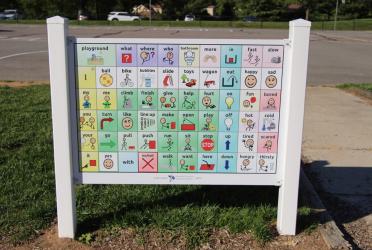
The boards – about 3 feet tall and 4 feet wide – are weather resistant and have pictures and clip art that allow semi- or non-verbal people to communicate, simply by indicating on the board what they are trying to say. Mom, Dad, hungry, hurt, hot, yes and no. Push, pull, stop, run, swing, slide, climb – the things a child at a park needs to tell people.
Dareth went into fundraising mode, found the people to help her make the Communication Boards come to life and put together Silent Spectrum.
“I have a new passion for advocacy and would love to share my knowledge and learn from others,” she said. “I looked at my life and my community and wondered what I could do to help make Slayton and the surrounding areas more aware of special needs.”
Her new organization – Silent Spectrum – is to help support special needs and children.
Goal #1 – Raise the $5,000 to pay for Communication Boards Goal #2 – Raise the $5,000 needed to pay for Roth ID tags for all children in Murray County Roth ID tags are a sticker that gets attached to a car seat. If the adult in a vehicle is incapacitated in an accident or event, the sticker can be pulled off the car seat and forms a durable bracelet that has the child’s name and emergency contact information. It also has a QR code that can be entered into the Roth data base.
The ID kits were created by the family of a woman who was killed during a 47-vehicle pileup in Ohio. Her two toddlers were brought to ER, but it took hours to identify them and contact family. In the two years since her family created Roth ID, over 500,000 of the kits and bracelets have been disbursed.
“We’re in all 50 states and 19 countries,” said Jennifer Shindler, sister of the woman who died. “Every time I see 100 kits go out the door, and I know that’s 100 more kids that are protected and covered.”
To purchase 1,000 kits is $5,000. Dareth wants to see them disbursed in Murray County by using area fire departments.
Fundraising for both projects has begun. Silent Spectrum accounts have been set up at both First National Bank and Minnwest, and can also be accepted via VENMO@silentspectrum.