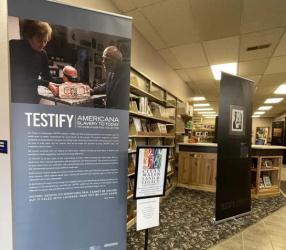
It was the late literary icon Maya Angelou who said, “History, despite its wrenching pain, cannot be unlived, but if faced with courage, need not be lived again.” That message parallels the one Alan Page and his late wife, Diane, hope to convey through their traveling exhibit called “TESTIFY: Americana from Slavery to Today.”
The exhibit, which includes 18 banners with information and various photos of artifacts from the Page family collection, is on display till the end of November at the Slayton Public Library. “It came from Alan Page, the former Minnesota Viking and Supreme Court Justice,” library director Lori Stainer said. “These are artifacts that his family has collected over the years and over generations. They actually had them in their home and it got to be too much for them to have in their home, so he wanted to do a museum exhibit.”
Stainer said the Page family hired a company to organize the artifacts and put them on display in the Twin Cities area.
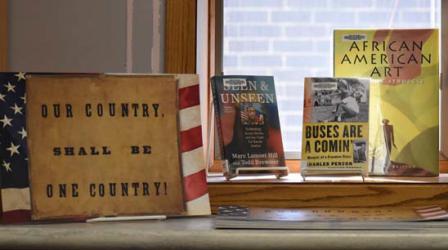
When they realized that a lot of people outside the metro area wouldn’t necessarily have the opportunity to view the collection, a traveling exhibit was created. “He hired a company to take the photographs, write the scripts and print up the banners,” Stainer said. “Plum Creek Library System bought the set, and so it has been traveling each month to a different library through the system. When all the libraries have had it, then it’s going to go to the county museums and any other orga-ham Lincoln funeral banner from 1865 that declared “Our country shall be one country.” There’s also a framed photo of nine young African American children labeled as “alligator bait” (ca. 1897) above a photo of the African American 9th Cavalry Regiment (ca. 1939 Kansas) — highlighting the lack of value and deep hostility directed at African Americans despite many of them serving honorably alongside them on battlefields.
A public sale notice to be held at 1 p.m. on Tuesday, March 5, 1833, in Charleston, South Carolina provides further evidence of the lack of value toward “Negroes.” The first individual for sale was listed as “a valuable Negro woman accustomed to all kinds of house work” and who has four children — two of which could be sold separately if it better suited the purchaser. Another references a 16-yearold “negro wench” that only has one eye. The sale also consists of “14 Negro Wenches ranging from 16 to 25 years of age, all sound and capable of doing a good days work in the house or field,” as well as several other males and females.
Stainer said there has been a fairly broad range of responses to the exhibit so far. “Some people come in and they totally ignore the display,” she said. “They just come to the desk, get their books and leave. But some people are very interested in it, and they ask a lot of questions. They walk through and they read the text on the banners very carefully. It’s there for them if they want to view it. It’s not required and it’s not like a class where you’re required to sit for a certain amount of time. It’s just at your own leisure.”
The hope in creating the TESTIFY exhibit in 2018 was that by bearing witness to the country’s past, Americans would better understand the racial divide of the present. There are many who believe that the past cannot be reconciled until the truth has been told, no matter how disturbing or uncomfortable that might be. And while younger generations of Americans aren’t likely to be guilty of committing past atrocities, their willingness to learn about those painful historical events and acknowledge how they impacted Black Americans could help prevent others from suffering through a similar painful history in the future.
“(Plum Creek) used Minnesota’s Arts and Cultural Heritage Fund to purchase it, so then we can all use it, share it with our communities and hopefully it will spark some conversations, spark some interest in history and maybe people will learn a little something,” Stainer said.
TESTIFY doesn’t sugarcoat the history, pointing out that America was founded on white supremacy and the lie of racial difference. Though there were other groups of people that were also marginalized, Black Americans specifically faced hundreds of years of slavery, along with Jim Crow era segregation and countless roadblocks from a multitude of places generation after generation. “The goal (of the TESTIFY exhibit) is to become conscious of ‘unconscious bias’ and to learn to recognize racism,” Diane and Alan Page’s daughter, Georgi Page-Smith, said as director of the collection. “Similar to a disease, we can then work on curing it, healing what’s broken, and doing the growth we need to do as a country.”
Along with items that might be somewhat shocking, the exhibit includes historical artifacts that portray the uplifting spirit of resilience, joy and celebration, such as artwork of jazz musicians, a family scrapbook and artwork of a graduation ceremony, painted by selftaught artist Clementine Hunter (1886-1988). The family hopes the exhibit will help bridge divides, deepen dialogue and encourage action on justice. “At a time when the past seems ever more present, the 100-plus objects in the exhibit will juxtapose artifacts from our often-painful, shared history with inspiring imagery and works of art that help us rise above it,” the late Diane Page said of the collection. “My hope is that by coming to grips with our past we can come together in the future.”
In addition to the banners, there’s also a small section of books available for checkout that Stainer bought to go along with the exhibit. That includes “All Rise: The Remarkable Journey of Alan Page.” The books are in a small area deemed “Testification Station” — a place where people can share their share their own stories or reflections alongside the written words of others. “People can sign the guest book,” Stainer said. “You can also look back and see what people from other libraries have put for comments.”
While library visitors can glimpse a small snapshot of the overall Page collection, a larger version is currently housed at Minneapolis Central Library’s Cargill Gallery. A permanent home for TESTIFY and the entire Diane and Alan Page Collection is being sought. “The Page family is fundraising now to find a permanent place for the exhibit,” Stainer said.
The Slayton Public Library is open from 10 a.m. to 5 p.m. Monday through Friday. For the Thanksgiving holiday, the library is closed Nov. 23, 24 and 25. Beginning Dec. 1, the exhibit will be on display at the Fulda Memorial Library.