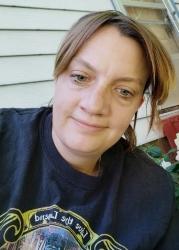
By Kim Maas It was August 8th, 2024. I was sitting by myself in my local clinic awaiting a CT scan. I had been struggling with breathing off and on for six months. Six months prior, I had an episode where I couldn’t breathe and tried doing telehealth for what I thought was a common cold. The doctor on telehealth told me I needed to go to urgent care in person and get a chest X-ray to see what the problem was. It was not something that could be diagnosed over the Internet. When I went to Urgent Care, I was told it was a regular cold, I did not need a chest X-ray, and that I would be okay in a number of days. I believed them, so the condition went on for six months until that CT scan.
I remember that day like it was yesterday. There is nothing like lying in a cold exam room in a hospital gown, completely afraid of what the results would be. It was a very traumatic experience for me because I used to give blood and had no problems with IVs. That day, they had to stick me six times, and finally, on the sixth time, it was done on my wrist, just to get the dye in for the scan. The scan took place in the morning. It was merely an hour later the results showed up in my patient portal. No one forgets what it feels like to open those results, to be standing alone in the parking lot of the clinic and see the words “twenty-centimeter tumor in the ovary in the abdomen.”
What happened after that is a haze as I remember having to tell my supervisor, my parents, my sister, and other family members. An array of tests followed, along with meeting with a gynecological oncological surgeon. And after that initial consult, my initial surgery, which was to be a full hysterectomy, had to be put back five to six weeks because when I was diagnosed with a chest Xray, it was found that I had bilateral blood clots in my lungs. If I had surgery right after I met with the surgeon, I would have died from being put under anesthesia.
I give this vivid account because no one understands the fear and anxiety of what it means to be diagnosed with cancer unless they live through it themselves or experience it as a caregiver for someone else. Since that day back in August of 2024, I have undergone chemotherapy for 18 weeks that failed, a splenectomy to remove a tumor on my diaphragm, radiation on malignant pelvic lymph nodes, and most recently Cryoablation on malignant lymph nodes near my sternum. I started treatment with one medical facility and have since had to go to another facility for further options. I have been told that there were no clinical trials available for me at the facility I started with and I am left with more options available to me where I sought a second opinion in case the cancer comes back in force.
I think the most important thing to keep in mind when anyone is diagnosed with cancer, or their loved one is, is patience and kindness.
Maas: Faith
Continued Page 6 No one knows what someone else is going through. Nobody understands the anxiety, panic, fear, guilt, pain, sleepless nights, etc. that both the individual with cancer and the family experience.
For me, what has been lifesaving has been returning to my faith and getting involved with Sacred Heart Parish in Waseca, MN. I have renewed my faith through taking pilgrimages, attending spiritual conferences, and volunteering at church. For anyone diagnosed with cancer, this need to belong and still feel human exists. How that can be achieved may vary for everyone, and there are support groups and therapy options that can help you find your own way.
What I have found most helpful is not to believe everything a physician says to you. Just because a treatment is prescribed as standard in medical books does not mean it is the most recent treatment available to you. There may be treatments that are available at institutions other than the one you started with, even if they have to be prescribed off-label with your insurance. You cannot be afraid to ask questions, even if it upsets your oncologist. You cannot be afraid to push for tests you researched that are necessary or helpful for your type of cancer. For me, I had to push through to the third facility and fourth doctor before a Signatera blood test specific to my tumor mutations and proteins could finally be ordered. I was told by two oncologists that the standard CA125 blood test was not working for me and did not seem to show my cancer recurrences. The Signatera test is the best option currently available for my type of cancer.
I also just discovered that a prior authorization at my local clinic for a PET Scan was denied. It was denied because the prescribing doctor failed to show that a CT scan wasn’t able to be done first. With my cancer, only PET Scans have caught my recurrences; CT scans have not. In the interim, what had happened before I received this denial letter was that I had gone against my local oncologist’s wishes to wait on scheduling a PET scan until the cryoablation and biopsy were done. He wanted me to have a PET Scan done at his clinic where the denial eventually was given. I did not want to wait to get the scan scheduled and wanted to put my time off request in at work as soon as possible; therefore, I had already gone to my new doctor and surgeon at the facility that was my second opinion. I ordered a PET Scan through him at his facility. Going with my new doctor and surgeon actually worked out in my favor. He works at a larger institution, an actual medical hospital and not a clinic, and that institution contracts with my specific group health insurance. I do not need to get Prior Authorizations when I have PET Scans done at his facility due to this contract.
I share this experience because this is something I just learned, and I work with insurance as my day job. Every day there are small idiosyncrasies with insurance we may not be aware of until something happens to either ourselves or someone we know, or we may be fortunate to learn about through reading somewhere. The smart thing to do when you have to go through cancer or help advocate for someone who has cancer is not to give up, not to believe that only the standard options of care are available to you, and to keep pushing for options if a doctor tries to close the door on you. Yes, that means even if you must ask for a second opinion and change care facilities.
Today, I am a cancer survivor living with what started as Stage 1 cancer and now is reclassified as stage 4B. I was given x number of months to live and x number of years to live. However, because of my faith, because of my ability to research my own options and to know more about my specific tumor mutations, and because of my stubbornness not to go with “there is only one option available to you” I am still living and breathing and walking today. I may not have a whole lifetime to live. That is in God’s hands, but I’ve been extremely fortunate to have the time I do have and to help educate others about the illness I’ve unfortunately been diagnosed with. The Big C can cause fear and anxiety; don’t let that fear and anxiety run over you or your loved ones by closing off your options. Know that there are financial resources, legal resources, and therapy resources available if you are struggling. I am walking the Relay for Life on August 8th, 2026, in Murray County because my friend and coworker invited me, because I have survived cancer, and because I believe in the cause. I invite you to walk, to donate, and to experience Relay for Life for yourself and help those like me who are a part of this journey.