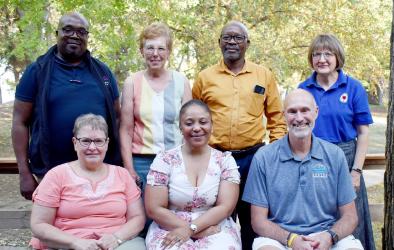
By Jenny Kirk Representatives of the
Ondini Circuit of South Africa recently came together with the dual intention of reviving their 15-plus year partnership to continue growing in their faith together.
The Lake Shetek Conference — the Southwestern Minnesota Synod of Evangelical Lutheran Church in America (ELCA) which includes congregations in the counties of Cottonwood, Jackson, Nobles, Murray, Pipestone and Rock — and the Ondini Circuit — the South Eastern Diocese of the Evangelical Lutheran Church in Southern Africa (ELCSA) which encompasses 60 congregations and 12 parishes — began their unique partnership in 2009 but communication efforts have dwindled somewhat since COVID-19 hit, so they are looking to reaffirm their commitments to each other. “My function in coming here is to try and revive the relationship that has been there since 2006,” said Agrippa Ntombela, who is the chairperson of the South Eastern Diocese, which includes 10 circuits. “It’s about sharing our faith as Christians, so that you grow in your faith. We also share our experiences. There are things Americans do bet-ter than we do, and there are things we do better than they do as Christians.” Ntombela said praying for each other was very important, as is in-person visitation. “It’s not easy to communicate with a person you’ve never seen,” he said. “It’s not easy to love a person you’ve never shared an experience with. But it’s different if a person comes and sees your face.”
Shetek Lutheran Ministries hosted Ntombela and two other South African delegates last Monday, Tuesday and Wednesday. The international visitors will continue their tour of southwest Minnesota through Oct.
12. “This is an opportunity to learn from each other, grow in friendship and faith and our Lord, Jesus Christ,” Shetek- Ondini Partnership Committee Coordinator Bonnie Frederickson said. “We welcome you.
We have work to do on our end to get things going for our partnership, and we are going to do our best to recruit and educate people about what this partnership is all about.”
In 2006, Rev. Beki Mathe was a visitor at the Shetek Conference Assembly held at Bethlehem Lutheran Church in Lakefield, the same church Frederickson attends. He saw all the agricultural land in the area and that farmers had done well there, so he asked if a delegation could travel to the Ondini Circuit to help them find uses for the land that was returned to the church by the South African government. The first trip to Africa took place in 2008. “It was basically a trip where they did an assessment of what the people needed and found people in the Ondini Circuit who would commit to working on these projects,” Frederickson said. “So they got to know people, enjoyed worshiping together and identified projects together.”
The second trip was in August 2009. They helped install irrigation at Hoffenthal and Emangweni in addition to helping plant 2,500 beet plugs at Kwazamokuhle. “I was on that trip, and I had never planted beet plugs before, but I helped plant 2,500 beet plugs,” Anita Holmes said. “They had doubled the size of the community garden at Hoffenthal from 2008 to 2009 and the Kwazamokuhle garden was fenced in one year’s time. They did a lot of work in one year. They were hard workers.”
The third trip took place in 2011, when the Shetek group helped the Ondini people with their version of Vacation Bible School for the youth — their youth being up to about age 35. They also conducted a lay leaders workshop and worked in the gardens. Frederickson traveled to Africa for this trip. “I remember them telling us, ‘You will not catch us sleeping’ as they were committed to carrying on the work when we left,” she said. “We also did some work in the gardens at Kwazamokuhle Diaconal Center, teaching food preservation and spent a lot of time building relationships with our brothers and sisters along with worshipping together.”
Some of the same things were accomplished during the fourth trip, in 2014, but cabbage was also planted in the garden at Kwazamokuhle. They again visited Hoffenthal Parish gardens and attended the Women’s Prayer League celebration in Ladysmith. “When they have these large gatherings, they’re festive,” Frederickson said.
“They worship and they enjoy each other. They dance. So it’s really a gift to see this.”
Delegates from the Shetek Conference Partnership Committee, including current partnership chair Andy Busman, went back in 2017. They met a lot of people from various parishes and attended a youth conference. “We participated in for the health and well-being of their communities in partnership with the Samani Garden Project in the Ondini Circuit, help fund school unforms for children, assist in lay pastor training and assist with health and wellness groups, including HIV/AIDS, tuberculosis and diabetes, to improve health.
Akhona Kleinbooi, the executive secretary of the South Eastern Diocese in South Africa and the first female nonpastor to lead and head the administration and finances of the church, is a strong advocate for health and wellness. She’d like to see recreational centers built in very rural communities, so that people could have access to fitness equipment and school children could have access to the internet in addition to just having a place to do their homework.
Kleinbooi is also passionate about education and wants to leave a legacy of successful leadership for future generations to build on. “For me, education is the only thing that actually opened doors,” she said.
The third delegate is Rev. Thabani Duma, who is in the South Eastern Diocese and is the “eyes and hands” of the church. “My main task is to oversee issues that have to do with natural disasters,” Duma said. “Over and above that, we are a food distribution.”
Duma’s work also consists of doings workshops, encouraging community gardens and distributing hygienic resources, such as soap, toothpaste and other sanitary items, to children across South Africa in order to improve confidence and selfimage. “We’re in collaboration with the school principals, so we can deliver these packs,” he said. “We want to help improve life, confidence and selfesteem, so these children can move on to do greater things in the future.”
While all the delegates are looking to refresh their partnership for the future, it’s also good to acknowledge that there have been life-changing events that have taken place already, so that the foundation is there to build upon. “The reason I got involved is because I thought I could make a difference and that I felt it was important to share my love of people and of God,” Frederickson said. “That’s the reason I went. People get involved because we believe we can make a difference.”
Tade said she recalls being on the street in Chicago, where she was attending seminary, when she learned Nelson Mandela was released from prison in 1990. She also remembers that years prior to that, during her college years, people prayed for the end of apartheid. “My husband is from the Central African Republic and he said people danced in the streets,” Tade said. “Then with me going to Africa and wondering why the black people were so poor. That’s when it really hit me. It’s because the Europeans came here and took the land. That’s the history of colonialism that you continue to live with.”
Ntombela believes people need to talk to one another and share experiences, so everyone can understand the full picture of what has taken place in the past and try to change for the better. “It’s a process for everybody,” he said. “It’s not only for white people. It’s also for black people because they must heal themselves.”
Holmes said it was an eyeopening experience to be in the minority population, as she was in South Africa. “It makes you see the other side of things,” she said. “But we were so welcomed and loved by the people in the Ondini Circuit. They are just so gracious. And I have to say they do church so much better in South Africa. Lutherans here in southwest Minnesota could learn a lot on how to hold a worship service. Most of them last about four hours and there’s a lot of singing and dancing. They show their faith much better than we do in America.”
Holmes added that she was surprised to learn that there was little communication between whites and black in a lot of areas of South Africa. She learned this when they went to visit a white farmer who owned a machine that made soy milk. “He was so surprised that we would bring black people to visit him,” she said. “That was 2009. Then we went into a farm store in Ladysmith and it was the first time they had seen black people that actually came and wanted to buy something at their farm store. So we were trying to open those gates there because they weren’t communicating between themselves.”
Kleinbooi hasn’t seen a person of color since she arrived in southwest Minnesota yet, so she understands what it feels like to be a minority. But oddly enough, she’s felt a sense of trust prevail as she’s been welcomed so openly here whereas there always seems to be a shadow cast, as if she, a black woman, was going to steal something if she was left alone back home.
Around the time Mandela was being released from prison, Kleinbooi was one of only a few black children who attended English speaking schools. She said black people are very educated in South Africa but still have difficulties rising to top positions — those are primarily held by white men. Oftentimes, it gets exhausting having to work so hard just to get employers to take you seriously, she said.
Kleinbooi is quick to credit a white man from Greece for lifting her to great heights throughout her banking career. “He told me at my farewell party that he never met a black girl that walked into an interview already thinking that she got the job,” she said, adding that he appreciated her confidence and the way she dressed. “You had no experience in banking then, but after you left the interview everybody said, ‘let’s take her,’” Kleinbooi said. I grew in the banking industry so much with him behind me, guiding me, teaching me. He had such a positive role in my life.”
Frederickson said they need more active committee members in order to sustain the partnership. Non-ELCA people have been part of the efforts in the past, she added. “From the get-go, the intention was to share what we have in common,” Frederickson said. “To work together, walk beside each other, learn from each other. It’s a different culture in South Africa and it’s a different culture in America, but that’s part of the uniqueness of traveling. It opens your eyes.”