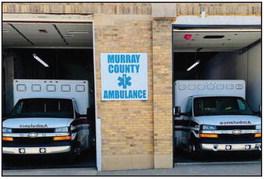
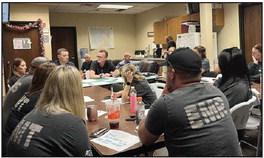
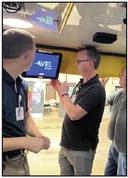
The Murray County Medical Center’s Emergency Medical Services became the first ambulance service in Minnesota to partner with Avel eCare EMS this past week when its ambulance crew took part in “Go Live” training with Avel eCare leaders.
Avel eCare EMS offers emergency responders the technology to consult with physicians, nurses or paramedics in realtime to improve pre-hospital care. “To be chosen as the first ambulance service in Minnesota to operate this program is an incredible honor,” Murray County EMS Director Jennifer Kirchner said. “We are so excited to utilize these services, push the program with our calls all the while serving our community with the latest technology and medical support.
Avel has truly created a one-ofa- kind program and we can’t wait emergency physicians, nurses and paramedics who understand and know the extreme conditions EMS face.”
Kirchner said they also went over the Scope of Service Guidelines in relation to their own protocols and examples of how to use Avel, what those look like and how they can assist them through many different forms — triage; airway, ventilation, oxygenation; circulation, hemorrhage or other cardiovascular needs such as running a cardiac arrest; trauma care; medication decisions as included in the BLS scope of practice; support ECG interpretation and readings; peer to peer consultation; procedural decisions; review of advisement on diagnostic test; poison control consultation; coordination of care with ALS intercept, Air activation and intercept, receiving facility activations and forwarding patient reports and updates; interpreter services and documentation or timed report-keeping as needed.
To close out the training, everyone packed into the ambulance and Kirchner made the first official call to Avel. “We went through how to activate the service, and everyone got to chat with the nurse on call at the time,” she said. “It was so fast and easy to activate. Within seconds of calling, they were up on the screen.” Part of the Avel installation required an onboard microphone and two speakers along with the iPad monitor and mounts. Fortunately, everything worked seamlessly. “Since ‘Go Live,’ we’ve placed two calls already utilizing the Avel nurses and physicians,” Kirchner said. “We can activate Avel even if we are not in the ambulance. They are also available to us via phone if we need assistance while on scene as well.”
The Murray County Ambulance ran 468 calls last year, averaging about 39 per month. Utilizing this new resource affirms the ongoing dedication and quality care of all of those involved. “In EMS, we rely heavily on our resources,” Having this durable setup truly connects us to experts who want nothing more than the best for our patients and communities. We look forward to the future and a multitude of possibilities that are to come.”
Kirchner said the program itself requires approximately $25,000 a year to operate but that Murray County Ambulance had been chosen to pilot the program for three years through Southwest EMS with 100% grant funding financial support. “Our service will not have any financial responsibility until the three years are completed,” she said. “Our Southwest Regional EMS Board of Directors are truly doing amazing things for our region and for EMS in all of Minnesota.”
The “Go Live” program is just one more way new technology is helping to improve services, especially in much-needed rural areas. Kirchner said she is excited to be spearheading the innovative and pioneering technology trial for Minnesota. “For years, we’ve walked into the ER and assisted our local providers and nurses with patient care while they dialed up telemedicine services for our rural facilities,” Kirchner said. I’m very familiar with the logic behind it and am overwhelmed to have this incredible service at our fingertips, especially with individuals who understand EMS and the scene struggles while trying to accomplish patient care that we encounter.”
Along with fulltime director and chief Kirchner, the Murray County Ambulance crew includes: EMS Office Assistant Denise Halbur (EMT part-time, captain), EMS Officer Nichole Gunnink (EMT fulltime, lieutenant), EMS Officer Richard Like (EMT volunteer), EMS Officer Ashley Haken (EMT volunteer), EMS Officer Roger Zins (EMT volunteer), Nikkya Betz (EMT volunteer), Dawson Blankenship (EMT volunteer), Angie Brinks (EMR volunteer), Diane Cale-Steinbeck (EMT volunteer), Logan Clarke (EMR volunteer), Gracie Haupert (Driver volunteer), Heather Hoekman (EMR volunteer), Paul Jacobson (EMR volunteer), Cole Larson (EMR volunteer), Lisa Leebens (EMT/Paramedic volunteer), Patrick LeTendre (EMT/Paramedic volunteer), Stacie Menken (EMT volunteer), Jenna Mollema (EMT/Nurse volunteer), Aarron Mollema (Driver volunteer), Mike Reith (Driver volunteer), Trisha Rowden (EMR volunteer), Hailey Swanson (Driver volunteer) and Danelle Thovson (EMT volunteer).