By Jenny Kirk You could say that Matt McNab was born to fly — in fact, he was actually in the air before he was born — but it’s taken a great deal of hard work and dedication coupled with his passion for aviation to get to the point where he’s at today.
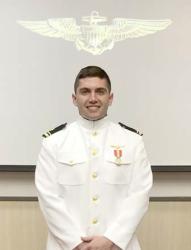
McNab, a 2017 graduate of Murray County Central High School in Slayton, is now a naval aviator, having successfully completed the rigorous training and requirements of the Navy’s flight program. On Oct. 13 at the Naval Air Station in Corpus Christi, Texas, Lieutenant Junior Grade McNab earned his golden wings at a pinning ceremony to commemorate the prestigious achievement. “It’s a great feeling,” McNab said. “It’s been a lot of hard work and studying, but it’s also been a very rewarding process, especially when instructors notice that or tell you that you did a good job and your grade sheets reflect that. (The process of becoming a naval aviator) has been super enjoyable. I absolutely love flying.”
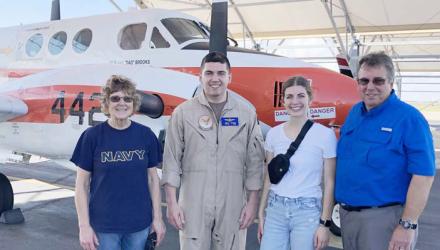
McNab’s parents, Connie and Mike McNab of Slayton, and his sister, Mary Lou McNab, who is in her first year of college at the University of Minnesota, Rochester, attended the pinning ceremony, as did local aviation mentor Cameron Johnson of Worthington. “You can have whoever you want pin your wings on you, so I asked Cameron and my dad,” Matt McNab said. “It’s pretty cool because they’re both pilots. Dad has a plane in Slayton and Cameron is an instructor who taught me to fly. Cameron operates a FBO (flight base operation) business at the airport called Integrity Aviation. He’s a really great guy. It was really nice having him down there for that.”
McNab’s family is extremely proud of him for all he’s accomplished and looks to continue achieving in the future. “It makes you feel pretty good when you see your kids do something like that and you get to be part of it,” Mike McNab said of the pinning ceremony. “It seems like whatever he did, from playing football or baseball, he did a good job. He put a lot of effort into it and it paid off. He’s still got work to do, but he’s kind of where he wants to be.”
Years ago, Matt McNab completed his instrument rating and got flying hours with Johnson, who was also Mike McNab’s flight instructor. “I couldn’t instruct Matt,” Mike said. “Back when he was in school, I’d let him fly once I got the plane up in the air, but we couldn’t log those hours. He was a student pilot with Cameron.”
Johnson had originally hoped to surprise Naval Aviator McNab with his presence in Corpus Christi, but he wasn’t sure if he’d be able to get on the base or not. Mike suggested he let Matt know. “It’s a good thing he did,” Mike said. “Cameron flew to San Antonio and then it was a 2 ½ hour drive to Corpus Christi. He met us at the hotel and we all went with Matt to the base. As you drive in, everybody’s got to check in. It was kind of neat because they all call him ‘Sir’ and salute him.”
Prior to finishing all phases of flight school, Matt McNab had the opportunity to fill out a preference sheet to request his future aircraft platform. Some of the choices include helicopter, fighter jet, tiltrotor and big wings such as the P-8 or E-6B Mercury. “You put your top three preferences in,” he said. “They also call it a dream sheet. I put in the E-6, P-8 and then jets. It worked out and I got the Mercury. It’s a Boeing 707, so it’s a big aircraft. It has four engines and it’s part of the TACAMO, which stands for Take Charge and Move Out, mission.”
Beginning this week, McNab will be based out of Tinker Air Force Base in Oklahoma City. Along with being an airborne command post, the E-6B Mercury serves as a reliable communications relay, linking the U.S. president and the secretary of defense with ballistic missile submarines, bombers and missile fields should nuclear weapons ever need to be deployed. There are typically 22 crew members aboard an E-6. “The E-6 will drop a long cable thousands of feet long into the water and somehow communicate with submarines that way,” McNab said.
While nothing is set in stone, McNab is likely to spend the next four years in Oklahoma, flying the E-6B. He could potentially return to Corpus Christi for two years after that to be an instructor and fly the T-55, which is soon replacing the T-44. The final two years of his eight-year commitment to the Navy are the least scripted. “Ultimately, it comes down to the needs of the Navy,” he said. “If you do well in your first four years, maybe you’ll get what you want after that. The last two years, they try to get you to a boat — you’re in the Navy, you should be on a boat — but there might be an alternative.”
Reflecting back, McNab said he’s known for a long time that he wanted to fly. “My dad took me flying when I was younger,” he said. “I always thought that was pretty cool.”
Some would argue that it’s in his blood. His dad got his license in October 1996, but his mom also took flying lessons many years ago. “She’s from Kansas, and I was complaining about driving back and forth,” Mike McNab said. “She said, ‘I’m going to look into signing us up for flying lessons.’ We took them together. She just got cold feet when it came to taking the test.”
While he grew up in nearby Brewster, Connie was raised in Kensington, Kansas. They met while she was working in Springfield. “We got set up by a dairy farmer,” Mike said. “We were married in January 1993.”
McNab said his wife completed the training and had even done her solo flight. “She flew her long cross country from Slayton to Sioux Falls to Sioux City back to Slayton,” he said. “The last time she flew was when she was pregnant with Matt.”
Along with his passion for flying, Matt may have also been impacted by several family members who served or are still serving in the military, including his uncle, Dan McNab, a captain in the Navy. “Everyone talks about wanting to fly commercially for the airlines, but it costs a lot of money on the civilian side of things, with having to pay for the training and the fuel,” Matt McNab said. “My uncle Dan told me about the ROTC (Reserve Officers’ Training Corps) and how it’s a good deal and pays for college tuition when you graduate college.”
After high school, McNab pursued a four-year degree in mathematics at the University of Minnesota, Twin Cities campus. Upon graduation in May 2021, there was a commissioning ceremony in which he transitioned from a student to an officer in the Navy. “Matt got into the Navy as an ensign,” Mike said. “That’s pretty neat. I have a brother that’s also in the Navy. He’s stationed in Japan. He’s been on submarines the whole time. During his last deployment, he was captain of a fast attack submarine.”
Mike said his brother, a nuclear engineer, was second in command on a submarine that carried nuclear missiles and he and the captain simultaneously pulled the trigger and launched the missiles. “There were no live ones, but many, many times during drills, they launched missiles,” Mike said. “One of those things that Matt’s plane can and will do is launch nuclear missiles if the president decides to do that.”
In August 2021, Matt traveled to Pensacola, Florida, known as the “Cradle of Naval Aviation” because everyone — regardless of whether they are there to train on jets, helicopters, big wings or so on — begins there. “We start with ground school classes, aviation and then some water survival training,” Matt said. “We basically swam in flight suits. Then we had seven flights on a small, general aviation plane. As an introduction, we flew a Cessna 182.”
The Naval Introductory Flight Evaluation (NIFE) program continued with more survival skills being taught, including “Helo Dunker,” which participants have to complete three times. “You’re in a pool, strapped in, wearing boots and a helmet in a helicopter fuselage,” Matt said. “They lower you into the water, flip the fuselage and you have to unfasten your safety belt and swim out. About six people go at a time. The third time, you wear night-time goggles to mimic the dark.”
Once that phase was completed, McNab traveled to Corpus Christi in April 2022, for primary training. His other option was to go to Milton, Florida, but since he knew he wanted to eventually fly big wing planes and that advanced training was in Texas, it made sense to go there for primary as well. “We flew the T-6 Texan, which is a singleengine, turboprop,” he said. “Going from a Cessna to a T-6 is like going from a tricycle to a rocket ship. It’s a lot faster — up to 6Gs, though we didn’t reach that speed.”
Again, there were ground school classes and written tests, but then they moved on to the simulators. “We started practicing everything we’d learned and then go out to the airplane,” McNab said. “It’s a crawl, walk, run mentality. The syllabus is called the Charlie syllabus.”
Focus areas include contacts and aerobatics — maneuvers like spins, a loop, half Cuban eight and barrel roll — as well as aircraft instrument utilization to and from stations and formations, similar to those presented by the Blue Angels.
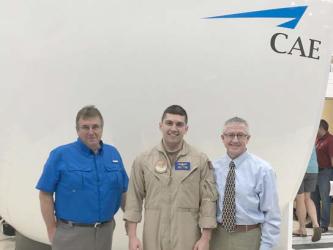
Advanced is the final phase of flight training. Planes flown include the T-44 Pegasus, a fixed-wing monoplane, and the Beechcraft King Air 90, which is a twin-turboprop aircraft. “We start out with ground school instruction, learning about engines, fuel, electronics and navigation systems,” McNab said. “Then we go back to the simulators and conduct check the list stuff.”
Later on in contacts, the Navy starts giving students engine failures, simulated fire, jammed power levels, prop malfunction, fuel leaks , flap malfunctions and other potential problems and malfunctions. “Anything can break when you’re in the real plane,” McNab said. “Everything is simulated, but you have to treat it like it’s real.”
For his cross country flight, McNab flew to Chicago, Illinois. Then it was time for the review stage. “This is when they give you tough scenarios to see how you react,” he said. “They want to see how good and sound of judgement you have and whether you’re backing yourself up properly.” After repeating several areas, he flew a plane while simulating aerial refueling, studied some procedures and did some additional formation flying.
McNab soaked it all in during his final flight, which was as the pilot of the T-44. “After my last flight — I got done early — I went home to be with friends and family,” McNab said. “It was good to see everyone for a week. I flew back down here on Columbus Day and on Friday the 13th, that’s when we had the pinning ceremony.”
McNab is grateful to have had positive role models and good support throughout his life. Seeking out advice from people ahead of him in flight school has also been a key to gaining valuable insight. “It’s great having those mentors to keep in touch with,” he said. When you’re with people who are passionate about what they’re doing, that’s what keeps you around, whether it’s being in the Navy or whatever.”
When he’s fulfilled his commitment with the Navy, McNab said he would like to fly out of Worthington with Johnson. McNab has his private pilot’s license, along with a commercial certificate, instrument rating and multi-engine rating. “There’s nothing guaranteed except death and taxes, but when I’m done with the military, hopefully I can fly cargo, like for Fed Ex or UPS.”