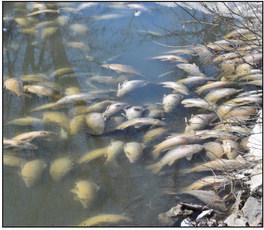
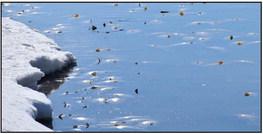
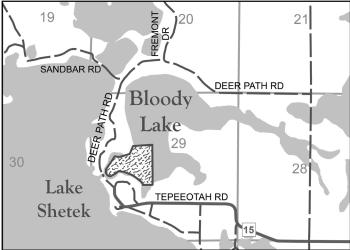
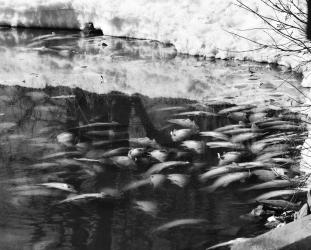
As the ice began to come off the channel between Lake Shetek and Bloody Lake recently, a grim reality surfaced with the sighting of countless dead fish. There were many catfish, walleyes and crappies lifelessly floating to the surface and scattered on the lake bottom near Bloody Bridge, but carp looked to make up a high percentage of the apparent winterkill.
Of course, there’s no way to know what the real extent of the situation is until all of the ice comes off this spring.
There were signs this winter, however, that conditions could certainly lead to fish die-off in several lakes in Murray County and beyond. “I would say the writing was on the wall with the low lake levels and all the snow we’ve had,” Murray County Parks Director Justin Hoffmann said.
Ryan Doorenbos, area supervisor for the Department of Natural Resources Windom Area Fisheries, agreed. “Reasons for winterkill are excessive snowfall, considerable Biological Oxygen Demand (BOD) that is due to live fish, decomposing organics, such as leaves or aquatic vegetation, and lower water levels due to drought do not help either,” Doorenbos said. “I would say this winter has been a tough year for fish and fishing in general in southwest Minnesota, though the extent of the winterkill in our area is unknown to this point.”
Lake Shetek and Bloody Lake are among the 14 Murray County lakes with aerator systems the same time we normally do. We got them put in at the end of December and into that first week in January.”
While aerator systems can lessen the impact of winterkill on small lakes in the area, they can’t necessarily prevent it from happening. “I personally don’t think there is anything to stop winterkill at times,” Doorenbos said. “When you have a tough winter, these lake systems do what they do and a small aeration system does not prevent the whole lake from experiencing winterkill. It’s sort of like asking the question, ‘How can we stop it from raining or snowing?’ It is a natural process and we have very little control.”
Hoffmann said the aerators are inspected by parks department employees once a week. “We check to make sure they are working and that all the ‘Thin Ice” signs are up,” he said. “They help, but they are not going to solve a problem like this. Mother Nature beat us this year.”
Dissolved oxygen levels are monitored by the DNR during the winter. Windom Area Fisheries tends to 80 fishing lakes in 10 different counties in southwest Minnesota, including Murray County. Doorenbos said the suspected winterkill between Lake Shetek and Bloody Lake is probably not an isolated event in the area. “We suspect this is one location of several lakes in southwest Minnesota that experienced partial winterkill,” he said. “While we have observed common carp, yellow perch, channel catfish, black crappie and walleye, the full extent of the winterkill is unknown. We won’t know the extent until the ice comes off.”
Doorenbos said the DNR has received reports of dead fish and bad-smelling lakes at other locations this spring. “We have had reports of anglers using cameras and seeing dead fish on Fulda Lakes as well,” he said.
Continued on Page 2.
Continued from Page 1.
“Fox Lake by Shetek had really low dissolved oxygen and had some smell coming from the water.”
Hoffmann stated that the parks employees hadn’t noticed dead fish in any other aeration system holes that they monitor. But with the excessive snowfall and cold this winter, it could just be a matter of time before the evidence appears. “I’ve heard people say the lakes are starting to stink, but I don’t know if that’s related to dead fish or not,” he said.
Determining where dead fish are coming from can be equally as complicated until the lakes open up. “It’s hard to tell where they’re coming from right now,” Hoffmann said. “The dead fish are being spotted in the channel that connects (Lake Shetek and Bloody Lake). It could be coming from one or both lakes.” The DNR anticipates analyzing the fish die-off levels in both areas. “We may have to do some ice-out netting, looking for presence/absence of certain species of fish to get a sense of the severity of the partial winterkill,” Doorenbos said. “Shetek was already set to be stocked with walleye fry. As far as other species, we’ll have to wait and see the extent of the kill.”
Other fish species typically found (alive) in both lakes in-clude sunfish, northern pike, bullhead, bigmouth buffalo and quillback, among others. And if the past is any indicator, Lake Shetek — the largest lake in southwest Minnesota — will rebound quickly. “The last partial winterkill of significance happened in 2010,” Doorenbos said. “At that time, a group of fish became trapped in the Valhalla area and winterkilled. The winterkill in 2010 had almost no impact on the overall fish population on Lake Shetek.”
While it’s difficult to speculate on the current situation, there’s always the potential for testing and stocking to re-balance an ecosystem. “The Fisheries will take their nets and go out and catch fish,” Hoffmann said. “They’ll go out this spring again, like they always do. They’ll do some testing and see how the winter affected the fish.”
For now, there’s the question of what to do with the smelly, decaying fish. “I’ve talked with the DNR a little bit and they haven’t really given us a black and white answer yet as far as what can be done with the dead fish,” Hoffmann said. “We need to know what can be done if people decide to take them off the lake. It’s not like it’s 10-12 fish. There’s likely to be thousands of pounds coming off, but we won’t really know till the ice comes off.”
Similar to 2010, Doorenbos said the DNR will inform lakeshore owners that it is their choice if they want to pick up dead fish. “As far as cleanup of dead fish, there is no requirement by lakeshore owners to pick up dead fish,” he said. “ Winterkill is a natural process that occurs in some winters that are harsh. While it is not pleasing to the eye or nose during the decomposition process, it is a normal phenomenon in lakes in Minnesota.”
Currently, there is no organized plan regarding the dead fish, but people may look for options in the near future. “Several lakeshore residences made the choice to work together (in 2010) to remove and dispose of winterkilled fish in a nearby field,” Doorenbos said. “Obviously, dead fish in small numbers can also be good to put on a garden for fertilizer or they can be put in compost.”