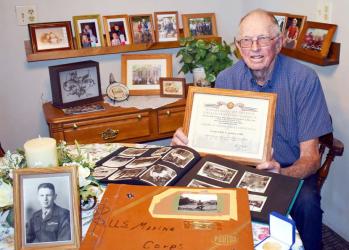
By Jenny Kirk Avoca native Dale Vosberg has mixed feelings about recently being awarded an Atomic Veteran medal and an Atomic Veterans Service Certificate — recognition he believes is coming 68 years late.
Vosberg, now 89 years old, is proud to have served his country, but he’s also disappointed that his own government intentionally subjected him and roughly 550,000 other servicemembers to high levels of radiation as result of its atomic testing — the Pentagon detonated dozens of nuclear bombs in the American Southwest and in the Pacific Ocean during the 1950s and early 1960s.
In March 1955, Vosberg, a Corporal in the U.S. Marine Corps, was at Camp Desert Rock in Nevada, when Shot “Bee” was detonated as part of Operation Teapot, one of several atmospheric nuclear weapons testing series secretly conducted by the United States between 1945 and 1962. Atomic testing underground also took place between 1951 and 1992.
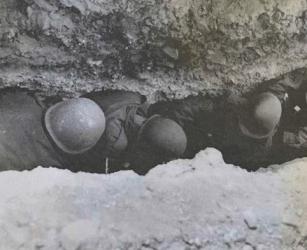
Witnessing the extreme power in both sight and sound is something Vosberg will never forget. “There was a 500-foot steel tower and the bomb was on that tower,” Vosberg said. “We were in trenches they dug with a backhoe. The trenches were about three and a half feet deep. And we were only 600 meters away. Then when the bomb went off, you had to stand up and face it, but the tower was totally gone up in the air. The bomb had melted it.”
Vosberg figures that most of his battalion from San Diego, California, was there that day. “They always leave a minimum behind for security, but there must have been 900 to 1000 of us there,” he said. “Some were laying farther away out in the open, just lying there in the desert. Then they had these guys standing around with big white suits on and they were holding rifles. One of them said their orders, if we tried to get away, were to shoot us.”
While the atomic weapons testing was a secret program back then, the truth eventually came out — the truth about the actual testing, it’s power and that veterans and some civilians were exposed to high radiation dust. “They falsified the documents of the actual power of the bomb,” Vosberg said. “People weren’t supposed to absorb so many megatons of radiation. They lied to the public because it far exceeded that. And you weren’t supposed to talk about it for 20 years. It never got talked about at first.”
Despite the truth coming out, the U.S. government has been slow to acknowledge the negative health effects on individuals due to the nuclear testing and radiation exposure, much like what happened to soldiers with Agent Orange and burn pit exposures. “One guy who rode home with me, he made it to 40,” Vosberg said. “And the guy from Pipestone made it to 60. He was in our outfit. It’s unfortunate because there has been a lot of cancer. Most of these guys are dead now.”
Vosberg is grateful to have had better health than so many of his fellow servicemembers, but he does take inhalants every day to help enhance his breathing. “When the bomb went off, it was a lot of pressure,” he said. “It burns all the oxygen out of the air, so all you breathe is that radiation dust. They had some buildings and tanks there, too. The tanks had rolled over and the paint was burned off them. You had to walk through there, by the damaged buildings and mannequins, afterward.”
Reflecting back, Vosberg said the soldiers weren’t provided any protective gear, such as masks or body coverings during the detonations. “They let us go to Las Vegas after it was over,” Vosberg said. “But they didn’t let us shower or anything. Then when we got back to (Camp) Pendleton, your pack and all that, you strapped it to the end of your bunk. None of that stuff got washed.”
Sometime after joining the National Association of Atomic Veterans, Vosberg received a letter stating that he was identified as a “high radiation victim” and that he was entitled to two physicals a year. “I had never gone to the VA before, but then I started going to the Sioux Falls VA,” he said. “They check you all over for everything. They’re very good. I don’t think (the government) realized what the long-term effect was and what it’s costing our government now, through the VA and all that.”
The U.S. government began conducting atomic weapon detonation testing shortly after it detonated atomic bombs over the Japanese cities of Hiroshima and Nagasaki in August 1945. The two atomic bombs dropped on Japan killed more than 200,000 people and created life-long health issues for thousands of others for several generations afterward.
Among the harmful effects of radiation, including issues with the heart, brain and thyroid, are birth defects in children whose parent(s) were exposed to high levels of radiation. “Environmentalists don’t want to use animals, so they used people,” Vosberg said. “I don’t think it’s still going on. They probably realized it was causing more harm than good. But I don’t think it was necessary at all.”
In an effort to make things right, the U.S. Department of Defense began issuing Atomic Veterans Service Certificates after Congress enacted legislation in 2019. Then in 2022, the DoD was required to create the Atomic Veterans Commemorative Service medal as part of the National Defense Authorization Act. “All of a sudden, they sent me a big plaque and medal, but it’s 68 years too late,” Vosberg said. “That’s the same thing as getting a ribbon.”
July 16 serves as National Atomic Veterans Day. While it was held in 1983, the day was not held again until 2022. The date is significant as July 16, 1945, marks the day the U.S. detonated the world’s first atomic weapon at the Trinity test site, now part of White Sands Missile Range in New Mexico. Three weeks later, Hiroshima was hit with a uraniumfueled device. Then three days after that, Nagasaki was hit with a plutonium weapon similar to the Trinity bomb.
This year, Atomic Veterans Day lands on a Sunday. While he’s thankful they are finally acknowledging Atomic Veterans Day, Vosberg wonders if they’ll ever make it a federal holiday. “Otherwise, it’s just like any other day,” he said.
Vosberg isn’t sure if he’ll be up to making the trip, but the National Association of Atomic Veterans did invite him to its annual picnic on July 16 in Ramsey, MN.
Vosberg’s Early Military Experience
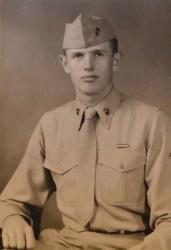
Dale Vosberg joined the Marines when he was 18 years old. He’d been working for Klasse in Westbrook. “He was the Ford dealer, the undertaker, the mayor, and he farmed,” Vosberg said. “Two classmates came in and said they were joining the Marines. They said, ‘Are you going with us or not?’ This was during the Korean War.”
Vosberg left his small hometown of Avoca — he was born and raised near the farm site in which he’s lived for decades — in February 1953. “I’d never been anywhere when I enlisted,” he said. “I got on the train in Minneapolis, and when I got to Las Vegas, I couldn’t believe it. The grass was green and it was warm.”
From there, Vosberg traveled to San Diego and then to Camp Pendleton. “Pendleton is named after a rancher that donated land to the Marines,” he said. “It’s huge and has all these little bases all over.”
Eventually, he boarded a ship headed for Korea, but never made it there. “The war ended when we were on the ship going over (to Korea), and they diverted us, all the 3rd Division, to Japan,” Vosberg said. “I was actually on an Army base. They had no place to put us. We were scattered all over Japan.”
Vosberg recalls it taking 19 days to reach Japan from San Diego by ship. While there, the Marines continued training. “We went to sea several times,” he said. “Off the coast of Okinawa, we hit a typhoon and everybody was sick. We went once to Iwo Jima and made a practice landing. Then we also did some winter training up on Mount Fuji. They kept you busy all the time.”
It wasn’t difficult for Vosberg to imagine what it had been like at Iwo Jima nine years prior, in 1945, when the U.S. captured the territory, since there were remnants of discarded military equipment scattered across the desolate volcanic island. “They took Iwo Jima for the airstrip,” Vosberg said. “But there were 29,000 casualties to take that island back in ’45. There were still junk pieces of ship and other kinds of junk on the shore. You could also see the pillboxes that were all dug in. They were all grown over, but they were still there. The pillboxes were like little cement rooms the Japanese were in.”
To get to the island, Vosberg said the Marines crawled down the nets from the ship into little boats, all while 8-10 foot waves jostled them around. The boats would circle around until everybody was off the ship. Then they went ashore. A practice landing was also made at Okinowa. “We spent about a week on a LST (landing ship tank),” Vosberg said. “That’s where the big doors open. We used an Amtrak, which goes in water and goes on land.”
Continue on Page 2.
Continued from Page 1.
Vosberg said they spent time near Kyota, a city that was never bombed during World War II because of its valuable cultural shrines. They lived in tents during that time, as they also did while training near Mount Fuji. “To the Japanese, Mount Fuji is very sacred,” Vosberg said.
Military life wasn’t all work. Sometimes the Marines hopped a shuttle bus to the EM (enlisted men’s) Club. Vosberg chuckles when he thinks about the happy hour night in which they could get any drink in the house for 5 cents. “On a regular night, it was 20 cents, and then one night a week, drinks were a dime,” he said.
In one of two scrapbooks highlighting Vosberg’s military service, there is a white bar rag with writing on it that reminds him of those days so long ago.
Transitioning to Family Life on the Farm After three years of active duty — he was also in the reserves for five years — Vosberg returned to the Avoca area. He met his wife, Mary Ann, and the two later married, on Feb. 23, 1957. “He said he was always proud to be a Marine, but he wouldn’t re-enlist,” she said.
If Vosberg had stayed in, it would have been during the Vietnam War. He said his older brother, Duane, was over there and nearly froze to death during the winter of 1951. “They lived in a hole in the ground on the backside of the mountain, so the shells couldn’t reach them,” Vosberg said. “Once a week, they’d go down, get a shower and have new clothes issued. They’d just burn the old ones. There was no place to wash anything.”
The way Vietnam veterans were treated when they returned home was also disheartening. “Our son-in-law came back to San Francisco and they couldn’t get off the plane,” Vosberg said. “People were throwing rocks at them. When I came back, the band was playing.”
The Avoca native settled into a new routine once back home. Over time, the couple welcomed five children — Sherri, Ruth, Joan, Paul and Mark, who all attended school in Westbrook. “We now have 12 grandchildren and 19 great grandchildren,” Mary Ann Vosberg said. “Luckily, most of them live fairly close.”
Four of their grandchildren — three grandsons and one granddaughter — also served in the military, a career fewer and fewer Americans are choosing to do these days. “At the time I went in, it you were more obligated,” Dale said. “It was a thing of honor. There were people from all walks of life. During World War II, 11% of the people served. Now it’s less than 1%. The average soldier during World War II was 5-foot-8 and 140 pounds, so that’s changed, too.”
For most of his life, Vosberg farmed corn and soybeans, but he also put up hay and raised beef cattle. His son, Paul, who was in the Army Reserve for 20 years, farmed alongside him. Things were tough when Paul was called up, but the family pulled together and survived. “We had about 700 cattle and we were farming a lot of acres, then all of a sudden, he was gone for a year,” Vosberg said. “He was in Iraq twice and also in Saudi and Kuwait. It was tough for us.”
For several years, the couple also hosted foreign exchange students, something they really enjoyed doing. “They were all very sweet,” Mary Ann said. “They liked being on the farm. They were eager to learn.”
The students came from Japan, Germany, Belgium, Brazil and Columbia. Dale said all of the families have visited a couple times over the years and that he and Mary Ann have visited the foreign exchange students in their native countries as well. “They invited us to come to Brazil, so for our 25th wedding anniversary, we went to Rio de Janeiro, to the carnival,” he said. “It would be like going to New Orleans for Mardi Gras. There were a lot of parades, bands playing and people dressed up. We spent about a month there.”
The couple also flew to Australia, where one of their daughters was a foreign exchange student. “That is one place that is really nice,” Dale Vosberg said. “It’s a long way — it was a 17 hour flight. I wouldn’t go now.”
Despite the fact that he’ll turn 90 years old on his next birthday, Vosberg continues to farm alongside his son. “I love farming,” he said. “I just like watching the crops grow. I’ve had to work really hard, and it hasn’t always been good, but overall for me, farming has been very good.”