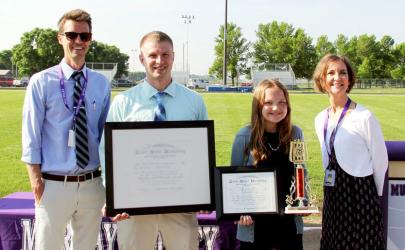
Murray County Central Elementary School’s Brielle Plotz was recently selected as the sixth-grade semifinalist in the 32nd annual Zaner-Bloser Na- best cursive handwriting among all the sixth-grade entries throughout the country.
Plotz was thrilled to learn about her accomplishment. “It’s exciting to be congratulated and awarded everything,” she said. “Last year, I was pretty bummed I didn’t even make it to state, so this year, I was really determined. We were given the papers for the contest really late, but I tried to practice as much as I could.”
Plotz explained that elementary students had the opportunity to compete in the handwriting contest but that no one is required to. “The teachers, every year, they print out one for every person,” she said. “We get the chance to compete. Some people don’t really care for it, but some people do. People who do, can ask for more copies, for more practice.”
All students write the required sentence “The quick brown fox jumps over the lazy dog” since it contains every letter of the alphabet. Judges select winners based on Zaner-Bloser’s four keys to legibility — the shape, size, spacing and slant of the letters. The fact that Brielle is left-handed creates a bit more of a challenge for her. “Since I’m left-handed, it was hard to do,” she said. “There would be marks from it. My hand would smudge the letters.”
Brielle’s mom, Betsy, pointed out that the smudges could be mistaken for erase marks. “Left-handed people tend to write at a different angle, but Brielle was really determined to get it perfect,” Betsy said.
It’s a good thing Brielle enjoys writing. In a video, she acknowledged that she likes cursive handwriting because of the way it looks and how it flows really well. “I’ve always liked journaling,” she said. “When it went into the COVID (lockdown), I wrote in the journal every day. I’d write what happened every day and that it was this many days since the isolation at school. I’ve always liked doodling and writing on random pieces of paper, too.”
Brielle’s achievement was highlighted on the last day of school on Friday, during the annual recognition ceremony. “We had the normal awards we get every year, but then there was a part of the ceremony where they gave recognition to me,” she said. “Mrs. (Casey) Gass said what the award was and gave me the trophy.”
Plotz noted that Gass was the one who coordinated the contest at the local level. She’s also the one who told Brielle the good news when the sixth grader was named a national semifinalist. Plotz stated that sixth-grade teacher Mrs. (Janese) Siedschlag was supportive as well. “She suggested I practice writing backwards,” Brielle said. “She’s the reading and writing teacher. And while I was given a trophy, my home room (with teacher Grant Harms) was given a plaque.”
Plotz also received a medal for her handwriting accomplishment at the state level. “We have these weekly assemblies, where our teachers give recognition for positive behavior, and I was given recognition for winning state,” she said.
When she was younger, Brielle and her classmates who participated were judged on their printed handwriting, not cursive, as they hadn’t learned that yet. “Each grade selects one person and that person goes onto the state,” she said. “Then for the state, there’s a winner for every grade. That one winner will go on for their grade to nationals.”
At the national level, judges select nine grade-level grand champions and nine gradelevel semifinalists. In addition, the Nicholas Maxim Award is given to two students with cognitive, intellectual, physical or developmental disabilities who excel in manuscript or cursive. About 2.5 million students have participated in the handwriting contest since it began in 1991.
This year, 49 states are represented among national and state-level winners. The contest, sponsored by educational publisher Zaner-Bloser is the longest-running and bestknown competition of its kind in the U.S. “Research tells us what handwriting can do to support cognitive development and better academic outcomes,” Zaner-Bloser President Lisa Carmona said in the news release. “That’s why we’re committed to recognizing those schools that encourage the use of manuscript and cursive, and the students who work so hard to master it.”
Writing by hand is said to engage more of the brain and enable better recall than using a keyboard and that learning to write letters by hand in the earliest grades helps children recognize the letters more quickly.
As the second of six children born to Betsy and Gary Plotz, Brielle has always been the crafty one in the family. Betsy said her daughter oftentimes gets the family “assignments” that involve drawing, creating or wrapping since Brielle is quite artistic. “She’s our only daughter and has a lot of responsibility, but in return, she loves school and teaching the younger children,” Betsy Plotz said. “She’s like a teacher. She has a natural talent. It’s neat to see something out there for those kids to recognize them. We’re excited for Brielle. She spent a lot of time trying to perfect things. She does try to be the best.”
The sixth-grade grand national champion is Freya Mojica of St. Joseph School – Fullerton in Baltimore, Maryland. As Plotz moves on to seventh grade in the fall, she’s not sure if she’ll have the opportunity to compete again or not. While the handwriting contest awards students in kindergarten through eighth grade, individual school districts across the nation typically decide which grade levels will participate. “Each school determines what grades they’re going to do it in,” Brielle said. “I think in seventh and eighth, you can sign up as an independent.”
Plotz takes part in several other activities throughout the year, including volleyball, basketball, swimming, band, choir and piano. “I like being outside and I baby-sit in the summer,” she said. “I’ve been doing band and choir since fifth grade and piano since first grade. In seventh grade, I’ll continue doing band and maybe choir. I’ve also done traveling basketball and JOs.”