By Jenny Kirk Murray and Pipestone County Cattlemen’s Associations recently hosted the annual Minnesota State Cattlemen’s Association Summer Beef Tour and Trade Show, providing valuable opportunities to connect with and learn from others in the beef industry.
People gathered early in the morning on Tuesday, July 18 for registration and a light breakfast at the Pipestone County Fairgrounds. Margie Salentiny volunteered to help service breakfast. “We all pitch in to make it a success,” she said.
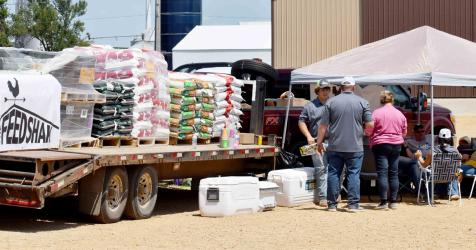
Nearly a dozen charter buses transported 630 attendees to the eight cutting-edge beef production operations throughout Murray and Pipestone Counties for the 2023 Minnesota Beef Tour. There were also more than 50 agricultural-related vendors scattered throughout the eight sites. “We raise beef as well, so it’s nice to get some pointers on the different styles of water systems, the way their gates are set up — there’s just a lot of knowledge you pick up by traveling and going around County Cattlemen’s Association and as the Region 7 director for the Minnesota State Cattlemen’s Association (MSCA). He farms in the Fulda area and is also the owner of The Feed Shak. He said, “It’s been very well worth the time and the effort
to offer this fun event. All the vendors are happy, so I’m happy.”
Murray County had the opportunity to host the annual state event one other time, back in the early 1980s. “Some of my customers told me about the time they toured in Murray County many years ago,” Salentiny said. “One of them is on the tour today. He’s 70-plus years old. He enjoys it.”
People came from all over the state but also from out-of-state. Barry “Slim” Cook traveled to the event from Wyoming. “I’m a cattle buyer and I send cattle back to this part of the country,” Cook said. “The tour has been a good opportunity to meet a lot of good people and solid industry people, to get their perspective on how they operate out here in southwest Minnesota.”
For the most part, Cook buys feeder cattle out of places like Wyoming and Montana and then connects them with customers in northwest Iowa and southwest Minnesota. This is the first time he’s attended the Minnesota Beef Tour. “It gives me a chance to see my customers and meet some new people,” Cook said. “I like coming back to this part of the country because there’s a genuine appreciation for the good genetics.
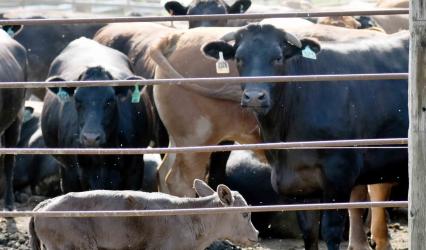
Ford Farms in rural Woodstock was one of the stops. Bob Ford and his son, Brady, do most of the farmwork, while daughter, Taylor, helps out on the weekends when she’s not busy with college classes. Together, they manage a 2,200-head feedlot with deep pitted slat barns. “It’s going well,” Bob Ford said about the tour experience. “People are asking how deep the pit is and how many cattle I put in each pen. These pens aren’t quite to capacity, but when they’re full, you can put 124 in a pen.
That would be 2,100 square feet per head.”
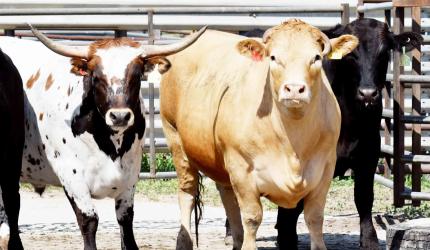
Ford typically raises black Angus, but he currently has a Charolais/Angus cross as well. “The feed conversion and yield is good on them,” he said.
The golden colored cattle certainly caught the attention of Thomas and Margie Salentiny. “They are some and modified distillers to create a balanced ration.
The tour buses also stopped at the Verlinde Farms in rural Tracy, where Wagyu-cross cattle are raised. The Japanese beef cattle are known for producing high prime cuts. “When you grade cattle, prime is the best, choice is next,” Ryan Verlinde said. “This breed makes prime almost all the time. With conventional cattle, only 5-8% are prime. There’s a huge difference.”
Verlinde said that very few people had heard about Wagyu cattle 10 years ago but that with more focus on organic and grass-fed beef, as well as an increase in different brands and labels, people are becoming more familiar with it now. “Twenty years ago, you just picked up any steak or roast at the grocery store,” Verlinde said. “People didn’t really care as much and didn’t necessarily have a taste for fine meat. Now, Arby’s is pushing the Wagyu burger. It’s becoming more and more popular, for sure.”
Verlinde said they started dabbling in the business of raising Wagyucross cattle just over 10 years ago. By 2019, the entire herd was Wagyu cross. “I run what they call commercial cows or cross-bred cows and we breed them Wagyu,” Verlinde said. “So everything here is just half Wagyu. That’s the most efficient, by far, and it still tastes very good.”
Between the farm Ryan and his wife, Marla, live on and the one across the road where he grew up the family keeps around 1,000 head of cattle. Verlinde’s grandfather Fermin started raising beef cattle there in the 1940s.
Verlinde’s parents, Richard and Lynn, continued the tradition of raising beef, sparking the opportunity for him to become a third-generation beef producer on the same farm. Currently, he keeps 250 cows on the home place. “We used to calve in the spring and the fall, but now we have them all calve in the fall,” Ryan said. “We have so many fat cattle around here now that we can utilize our pens better with fat cattle in them. The downside of that is it costs more to feed that cow and that calf in the winter because she’s trying to nurse that calf and get bred back.”
Verlinde takes on more risk by raising Wagyu-cross cattle because on average, he feeds them a year longer than most beef producers would. But the premiums the cattle bring are worth taking the risk. “We feed them a long time,” Verlinde said. “I’ve told a lot of people that we put our cattle in a crockpot and slow cook them. Most everybody else puts them in a microwave. They want the microwave popcorn right now.”
The rural Tracy farmer said there aren’t many other Wagyu cattle being raised in the area right now, especially on such a large scale. Currently, there are three full-time employees there besides Verlinde and his teenage sons, Lawton and Nolan, to do most of the work. Daughter Lauren is a college student and has a summer internship but also helps when she can.
The kids have shown beef in 4-H for many years. Verlinde calls it their hobby. “I don’t have a boat, motorcycle or snowmobile,” he said. “We just show cattle.”
Along with the benefits of teaching them about responsibility, care management and hard work through 4-H, advanced technology has impacted the family business in positive ways. A sophisticated surveillance system helps track the daily activities on both farms. Each calf also gets an electronic chip and everything is tracked on a system called Performance Beef. “I know exactly how many are in each pen and what groups they are,” Verlinde said. “Then it tracks what and when they were fed.”
Other Murray County stops included Monogram Meats (history and virtual tour of plant) and Schuur Concrete (specializing in bunks and slats), both in Chandler. In Pipestone County, showcased farms were Heartland Colony of Lake Benton (30 working employees), Brinkmeyer Farms of Holland (open feedlot), Baustian Farms of Jasper (feedlot) and Chestnut Angus of Pipestone (cow/calf and feedstock).
Buses returned to the Pipestone Fairgrounds around 5 p.m. and a steak supper was served to everyone, with fellowship continuing into the evening. “It’s been a wonderful day, and we’ve had nothing but good feedback about it,” Margie Salentiny said. “And tonight’s steak supper was the perfect ending to the day.”
Darcy Carlson won the top raffle prize, a fully processed Wagyu beef donated by Verlinde Farms and worth $5,500.
On Monday, July 17, a MSCA quarterly meeting was held. And there was also a MSCA Political Action Committee (PAC) fundraiser, which included a beanbag tournament, silent auction and dinner at Key Largo on Lake Shetek.