By Jenny Kirk Wintery conditions have delayed the 10th annual maple syrup making process at Shetek Lutheran Ministries but there’s still a great opportunity to jumpstart spring by attending its Sugarbush Square Dance and Pancake Breakfast on March 25-26.
The annual free-will offering events are open to the public and serve as the biggest fundraiser for the environmental education program at Shetek Lutheran Ministries (SLM). “There are other fundraisers out here for camps, like the quilt auction and golf tournament, but all of these funds go specifically to the environmental program to help further our maple syrup program and other events.” stated Environmental Education Director Katie Chapman.
The Sugarbush Square Dance will be held from 6-8 p.m. on Saturday, March 25, with refreshments provided. “The dance takes place in our activity center, and you absolutely do not need knowledge beforehand,” Chapman said. “You can walk out an expert. It’s so much fun. It’s a great way to kick up your heels and get ready for spring.”
Chapman envisions the dance celebration to be similar to the one referenced in Laura Ingalls Wilder’s book, Little House in the Big Woods, when families finally get together after the big winter. “We want to highlight that pioneer spirit,” Chapman said. “They had a dance after dinner and after the guys made maple syrup. It was a time to welcome spring.”
Anne Carter, a square-dancing caller from the Twin Cities area, will guide people through the dance moves. “She’s an absolute riot,” Chapman said.
The Sugarbush Pancake Breakfast will be held from 9 a.m. to 1 p.m. on Sunday, March 26 at SLM. Along with pancakes and syrup, sausage, fruit and a juice cup complete the meal. “We’ve served anywhere from 125 to 200, weather- depending, so it’s a very popular event,” Chapman said. “It’s so much fun, especially because of the fact that you get to come out and see maple syrup being made, smell the wood smoke and taste the syrup right out of the evaporator.”
Chapman said the fireplace will be going, and that she anticipates plenty of camaraderie as attendees sit around the tables enjoying a fresh, hot breakfast.
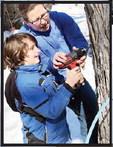
Making maple syrup is serious business at SLM, but the process is a labor of love since it is shared with so many. When the sap begins to run, it becomes a very busy time for Chapman, as well as her husband, Charlie, their children, Lydia and Francis, and a lot of volunteers. “It’s been fun seeing the kids grow up always knowing how to make syrup,” she said. “They’re busy running buckets and tapping trees, but they’re really good at taste testing. Later, you have to pull them off the ceiling, but they do a really good job. They’re really intuitive.”
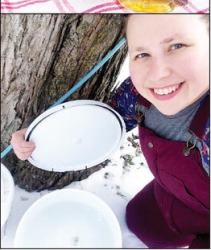
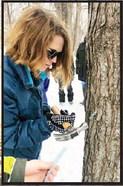
Chapman said Lydia has enjoyed transitioning into the bottling process, while their “big young buck” Francis is great at checking trees to make sure they’re not running over and then carrying the full buckets. “Each bucket is about 35-40 pounds when full,” Chapman said. “Each tree can fill between one and three buckets in a day, and we have about 80 trees total.”
Once conditions are ready — temperatures need to consistently be above freezing during the day and below freezing at night — the syrup-making process spans six to eight weeks. “A true run is when the frost comes out of the ground,” Chapman said. “Temperatures have not been conducive this winter yet. Each tree has a couple feet of snow around it, acting like a giant blanket. Once it starts to melt and the snow goes away, the ground will thaw a little bit.”
Basically, the trees are locked up right now, Chapman said, adding that she has 500 empty bottles waiting for syrup to go into them. “It’s been hard to have such a slow start to the year,” she said. “Every maple maker is chomping at the bit to get going.”
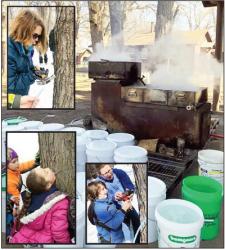
Once the process starts, there will be nonstop clouds of steam surrounding the evaporator. “Our evaporator can boil off 10 gallons of steam per hour,” Chapman said. “When you’re making syrup, you get the water out of the sap. What’s left behind is a lot of sugar. So boiling out the water, it just comes off in clouds and clouds of steam. It’s an insane amount of work, but it’s so much fun because of all the connections we’ve made.”
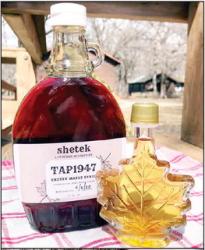
Once the sap is collected and boiled down, it is bottled as SLM’s Tap1947 homegrown maple syrup. And while the end product is priceless, it takes a lot of work and equipment to get to that point. “There are all kinds of different expenditures that come along with making maple syrup, like buying bottles, volunteers’ time, tapping materials and other equipment,” Chapman said. “The fundraisers help determine what we’re able to do to make syrup in the future.”
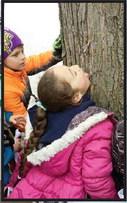
Countless people of all ages have had the opportunity to learn about the maple syrup making process over the years. Chapman has already facilitated five youth field trips and held a couple of seminars this year as part of SLM’s environmental education program, with many more scheduled. “It’s great to have different groups come out,” she said. “They’re all ages and from all different walks of life. There are so many good memories made out here. And we keep growing.”