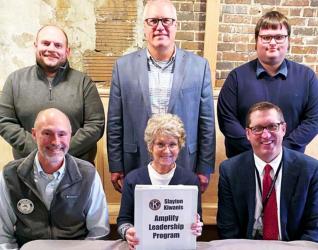
Slayton Kiwanis recently had the opportunity to have six of their members attend a leadership conference as part of the International Kiwanis training program. The seminar was titled “Become the leader you were meant to be.” This week and the following weeks you will see reflection articles from those who attended the training. Joe Meyer, Josh Malchow, Jakob Etrheim, Luke Schryvers, Marv Nysetvold, and Karen Tommeraasen.
Everyone can identify a great leader. But what makes a leader great? It takes education and training. Kiwanis International is training the next set of great community leaders through Kiwanis Amplify, a new online leadership development program for those who want to amplify their team-leadership skills.
Participants learn how to improve more than their Kiwanis club. They gain skills to improve careers, communities, schools and the lives of adults and children everywhere. Last year, more than 700 Kiwanians from 41 districts on five continents participated in the first class of Kiwanis Amplify.
Registration for the second class is open until February 25, 2022. The program starts March 7.
“I’ve had the opportunity for leadership training with companies like American Express, Hilton Hotels and Disney,” said Kelly Pena, a Kiwanis Amplify graduate from the California-Nevada-Hawaii District. “And I will tell you that Kiwanis Amplify rates up there with these top companies’ leadership programs.”
More than 85% of those who responded to the post-program survey said they learned at least one new thing from every module. “This program has given us the opportunity to invest in our own club members in providing leadership knowledge and training,” said Jean Long Manteufel, another graduate from the Wisconsin-Upper Michigan District. “And it is awesome.”
The first class of Kiwanis Amplify graduates also recommended some changes, including the introduction of new modules at a slower pace and more collaboration opportunities. Most of the presenters — experts in their fields from around the world — received high marks. Those who didn’t have been replaced with other contributors.
Kiwanis Amplify is conducted online. Participants can complete their assignments at a time that’s convenient for them. Eight leadership topics are covered in the course:
• The qualities of a good leader.
• Methods of communication.
• Planning engaging events.
• Promoting diversity, equity and inclusion throughout a team.
• Working with others.
• Sharing a message.
• Strategic planning.
• Self-care.
For more information check out the website kiwanis.org/ amplify.
REFLECTION FROM JOE MEYER
Six Competencies to Inclusive Leadership
In being provided the opportunity to go through the Kiwanis leadership program “Amplify”, I have been able to develop, grow, and amplify my ability to lead in my career and community. One component of leadership that I learned and would like to share is that of being an inclusive leader. Inclusive leaders tend to share six signature traits that not only promote diversity on their teams, but also improve their capacity to innovate and deal with uncertainty.
By studying inclusive leaders from around the world, results of research have shown that such leaders possess six fundamental traits that help to grow diversity on their teams. These traits allow leaders and managers to engage much more effectively with a wide range of culturally, demographically, and attitudinally diverse stakeholders. They also help leaders access a broader spectrum of ideas and perspectives, which can improve their decision-making and their ability to innovate, handle uncertainty, and anticipate the future. What leader doesn’t want to develop in those areas?
Definitions of and approaches to inclusive leadership tend to vary worldwide, and the six characteristics listed below represent just one conceptual framework for developing inclusive behaviors and encouraging diversity.
Commitment. Inclusive leaders are driven by their values, including a deep-seated sense of fairness that, for some, is rooted in personal experience. Inclusive leaders believe creating a welcoming culture begins with them, and they possess a strong sense of personal responsibility for change. When leaders devote time, energy, and resources to nurturing inclusive workforces, by investing in people and inspiring others to share their passion and goals, their actions signal a true commitment.
Courage. Inclusive leaders demonstrate courage in two ways. First, they are not afraid to challenge status quo organizational attitudes and practices that are always the same or similar as them, even if their recommendations are politically or culturally unpopular. Nor are they afraid to display humility by acknowledging their personal limitations and seeking contributions from others to overcome them. Some leaders find it difficult to admit they don’t have all the answers; in that respect, courage and humility go hand in hand.
Recognition of bias. Inclusive leaders understand that personal and organizational biases narrow their field of vision and make it impossible for them to make objective decisions. They exert considerable effort to identify their own biases and learn ways to prevent them from influencing talent decisions. They also seek to implement policies, processes, and structures to prevent organizational biases from suppressing diversity and inclusion. Without awareness, inclusive leaders understand that their natural inclination could lead them toward selfcloning.
Curiosity. Open-mindedness, a passion for learning, and a desire for exposure to different ideas have fast become leadership traits crucial to success, especially in challenging times. Curiosity and openness are characteristics of inclusive leaders, who are eager for other perspectives to minimize their blind spots and improve their decision-making. In addition to accessing a broader array of viewpoints, inclusive leaders’ ability to engage in respectful questioning, actively listen to others, and take in a range of ideas makes the people around them feel valued, respected, and represented. Inclusive leaders also refrain from making fast judgments, knowing quick decisions can stop the flow of ideas on their teams and are frequently tinged with bias.
Cultural intelligence. While an understanding of cultural similarities and differences is important, inclusive leaders also recognize how their own culture impacts their personal worldview, as well as how cultural stereotypes influence their expectations of others. Inclusive leaders take an active interest in learning about other cultures and seek out opportunities to experience culturally diverse environments.
Collaborative. Inclusive leaders understand that, for collaboration to be successful, team members must first be willing to share their perspectives. At its core, collaboration is about individuals working together, building on each other’s ideas to produce something new or solve something complex. But while collaboration among similar people is comfortable and easy, the challenge and opportunity thrown up by the foundational shifts is collaboration with diverse others that include employees, customers, or other stakeholders. Inclusive leaders assemble teams that are diverse in thinking and work hard to ensure that team members respect each other and that there are no out-groups within the team.
Becoming more aware in all areas is critical to self-development, but awareness in isolation is not sufficient enough. Without humility and empathy, it’s difficult for leaders to gain deep insights into the nature of their blind spots and therefore it is hard to grow. This requires effort, but fortunately the circle of learning is morally good. Leaders who are humble and empathetic will be open to criticism about their personal biases, and a greater self-insight into personal limitations will prompt greater humility, empathy and perspective. Not only are these behaviors critical for a leader’s personal development, they also serve to make others feel more included along the way. This is the ultimate objective of being an inclusive leader.