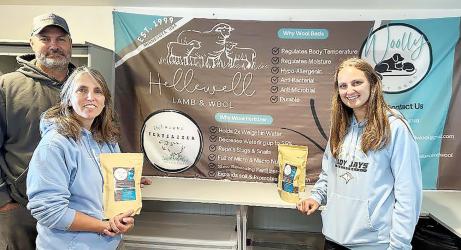
By Crystal Reith After years of low market prices for raw wool, Blair and Tami Hellewell began researching ways to add value to their product. “We came across studies on wool fertilizer pellets from the University of Vermont,” said Tami. “Some other producers have been doing it, but none in this area.” The Balaton couple and their three daughters, Ashley, Jayda and Joelle, spent three years exploring the concept and have spent this year developing and marketing their 100 percent natural Ewe’nique Fertilizer product. To create the fertilizer pellets, sheared wool is first cleaned. Then, it is fed into a pellet machine where it is heated and processed into pellets. The pellets are cooled and then packaged.
“We sell the pellets in eight ounce and 16-ounce packages,” said Tami, who is planning on having a vendor booth at the Murray County Fair and the Autumn Boutique. “One-half cup of pellets per every gallon of soil covers 15 square feet.”
According to studies, wool pellet fertilizer offers a variety of benefits to soils. Fertilizer pellets repel slugs and snails, contain micronutrients and macronutrients that are beneficial for soil and promote root growth. It also allows for a slow release wool. “I wanted to use wool more and teach people more about the wool industry,” said Jayda, a 2024 Murray County Central graduate. “Wool can be used for multipurpose.”
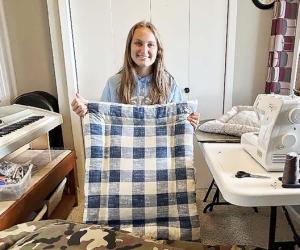
Under the brand Woolly Cozy Beds, Jayda uses 100 percent cotton canvas to sew dog beds. She uses clean raw wool from the family’s flock to stuff the beds. She can also custom order the beds and add a personalized name to the bed. While the cotton allows the wool to breathe, the wool helps regulate body heat, is fireproof and can help regulate water. The wool is also antibacterial, antimicrobial and hypoallergenic. It can also help regulate the nervous system. “They’re not too hard to make, but stuffing is the hardest part,” said Jayda, who is currently pursuing an agriculture production associate of applied science degree at Minnesota West in Worthington. “It does take a lot of planning, motivation and focus. It’s taught me a lot about managing time and learning new things.”
As an occupational therapist during the school year, Tami agrees that time has been a challenge but enjoys the opportunity to work as a family. “It’s great to incorporate the family,” said Tami. “The girls have always helped with lambing, vaccinations and bottle feeding. All have been involved in the process since they were little.”
Blair and Tami invested in a small flock of sheep when they got married in 1999 and have continued to grow their flock of commercial ewes.“Animals helped me get started in farming in the United States,” said Blair, who was raised on a sheep farm in New Zealand and came to the United States through the Minnesota Agriculture Student Training program in 1997. “I chose an animal I thought I knew a lot about.”
While the breeds, diets and performance of sheep in the two countries are vastly different, Blair turned to the Minnesota West Lamb and Wool program in Pipestone and his exchange host family Ron and Connie Schwartau, of Balaton, for advice.
“The lamb and wool program has been instrumental in growing our business,” said Blair. “It’s a great program that offers continuing education and meetings throughout the winter.” The program also offers regular farm tours and online classes. “If you’re just starting with sheep, I highly recommend you join or do a course through the lamb and wool program,” said Blair. “It’s a great group of producers that are all willing to share.”
In addition to the sheep operation, the Hellewells also farm 49 acres consisting of corn, soybeans, alfalfa and oats. The couple believes diversification can help others be successful, but they also encourage others to do their research and do something they are passionate about. “This stems from a passion of Blair’s growing up with sheep and learning about a different process from New Zealand. Then, us growing it and learning,” said Tami. “Now, we can take the wool and add value to that.”