A RAW MEMORIAL DAY SPEECH REMINDS US ALL WE NEED TO DO OUR PART & “PUT THE CART BACK”
For many, Memorial Day is about honoring those who gave the ultimate sacrifice. But for Matthew Prairie, who gave the Memorial Day Address in Balaton on Monday, it’s about much more than that.
Prairie, the son of Fay and Doug Prairie of Balaton and a 2003 graduate of Tracy Area High School, put his life on the line as a career special operations soldier serving first in the Green Berets and then later in our country’s most-elite counter- terrorism unit. “Growing up here gave me all the tools I would ever need in life,” Prairie said. “During my career, I made it to an organization that only about 1,500 people have ever made it to in the last 50 years. This community fielded a warrior and gave me all the grit, determination and mental toughness I would need to carry me on an epic journey.”
Prairie spoke from his heart as he thanked family, friends, teachers, coaches and community members before discussing disconnectedness to the large audience gathered at the trū Shrimp Campus Auditorium. “Today is for us to collectively come together as a country, a society and a community to remember that freedom is not free,” he said. “Ceremonies such as this exist to communicate the experiences of the few to the many. Our wars are fought in faraway places and the consequences of the decisions that our political and military leaders make are essentially unfelt by our society. During World War II, approximately 10% of the U.S. population served. Today, that number is around 1%.”
That 1% includes many individuals who have deployed numerous times. With fewer people being touched personally by the tragic loss of a service member, Prairie decided it would be valuable to share a few stories of fallen soldiers known to him.
The first time he experienced the death of a fellow soldier was on May 25, 2008, when he was on his second deployment to Iraq. Prairie was in the third vehicle, serving as a gunner in the turret on the .50 caliber machine gun, when the lead vehicle in the convoy was struck by ammunition designed specifically to penetrate vehicle armor.
Prairie quickly scanned 360 degrees for any indications of a complex attack, and after seeing none, turned his attention back to the lead vehicle, which was starting to catch fire. “I crawled out of the top of the turret, jumped onto the hood and then down to the ground, and began running toward the burning vehicle,” he said.
While Prairie was able to free two of the men (both with mangled legs) from the vehicle, the third was either killed instantly or eventually burned to death — a scenario that still haunts Prairie to this day. “Frank was 25 years old and on his fourth combat deployment,” he said of the fallen soldier. Early on, Prairie had a “bleeding heart” for the enemy, believing they should be treated with respect and dignity as well as given a fair chance at keeping their lives. Eventually, however, he learned that war is the ultimate cage fight in which two men enter and one man leaves. “Only one man gets to go home and you have to decide if you are willing to do whatever it takes to survive,” Prairie said.
Sometimes, there is no compromise. There was no compromise to be made with Nazi Germany during World War II. Prairie said Dick Pickney, a WW II Veteran originally from Garvin, must have witnessed things beyond human belief as he was one of the first few Americans to enter the Nazi concentration camp at Dachau. Still, he seemed at peace and content with life. “It speaks to his incredible resilience, but somewhere in the deep dark recesses of his mind, I’m sure he struggled with those images for the rest of his life,” Prairie said.
It was when Prairie and his team were deep inside ISISheld territory on a mission to kill or capture an ISIS member who was working on developing biological and chemical weapons to be deployed in Western countries that he distinctly remembers coming to grips with the survival reality. They’d been in a prolonged firefight with the ISIS fighters who were barricaded inside a building, when a woman slowly emerged from the building. Despite telling her several times in Arabic and English to raise her hands and not come any closer, she wouldn’t listen. “It was pitch dark, but I could see her plain as day with my night vision,” Prairie said. “I watched in disbelief as she slowly removed the pin from the grenade that was clutched in her hand.”
Shrapnel pelted Prairie’s forearms and one of his teammates was severely injured after the woman hurled the grenade. “From that night forward, I erred on the side of ensuring that me and my mates would go home alive and that I would never again show mercy and risk my sons growing up without a father,” Prairie said.
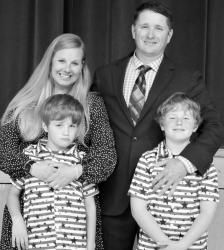
While Prairie is among those who strike fear into our nation’s adversaries as one of the world’s most lethal warriors, he’s also a loving husband and father. He and his wife, Mandy, have two sons — Carson (11) and Everett (9). “I spent a pretty significant portion of the last 20 years deployed outside of the United States and sometimes it was a surprise,” Prairie said. “Four months out of the year at my last unit, I was ‘on call,’ meaning that if I got an alert, I needed to report within one hour, ready to deploy anywhere in the world.”
For years, Prairie couldn’t talk about his missions, but since retiring in October after 20 years of service, he’s sharing some of his experiences to help others understand the efforts and sacrifices service members and their families truly make. “On several occasions when my phone rang, I grabbed my ‘go bag’ that was already packed, I kissed Mandy and the boys goodbye and I left,” he said. “I didn’t need to tell her that I couldn’t tell her where I was going, I didn’t know when I would be back and that I didn’t know when I would talk to her next. She already knew all that.”
While he’s not suggesting that everyone needs to serve in the military and go to war, Prairie does propose that we all owe our country something and that we are all capable of contributing to the greater good in some way. Something as simple as putting your grocery cart away appropriately indicates good citizenship. “You have to be internally motivated to do the right thing and it reflects a person’s character,” he said.
Oftentimes as a society, we suffer from a lack of concrete action. Everyone is quick to take to social media and talk about things but no one wants to actually do anything. “We all need to put our grocery carts away,” Prairie said. “We need to take the simple actions that we are all capable of to make the world a little better of a place. This is how we honor the sacrifices that so many have made for us.”
Prairie received a standing ovation and was approached by a long line of well-wishers after the program. He and his family currently live in Vass, North Carolina. His wife Mandy is the daughter of Jolene Dierks of Hadley, MN and Jim Dierks also of Hadley, MN. She was a MCC graduate.