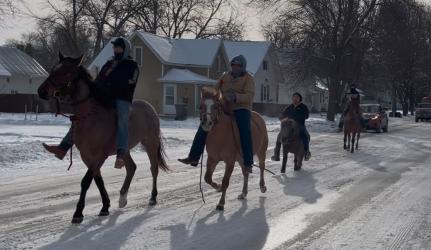
By Crystal Reith The Makatoh Reconciliation and Healing Horse Ride honors ancestors, shares history and provides healing. The ride also serves as a powerful tribute to the 38 Dakota warriors executed in 1862 following the U.S.–Dakota War as well as two Dakota chiefs, Medicine Bottle and Shakopee, that were hanged in 1864. These hangings, ordered by President Abraham Lincoln, remain the largest mass execution ever carried out by the United States government.
The journey began as a dream in 2005 by Jim Miller, a Lakota spiritual leader from Porcupine, South Dakota. Despite the frigid temperatures, his vision became reality in December 2008 when horseback riders made the 330-mile trek from Lower Brule, South Dakota to Reconciliation Park in Mankato, Minnesota.
Originally called the Dakota 38+2 Memorial Ride, the event ended in 2022 when Miller announced that it would be his last ride. Miller passed away in 2023, and while his absence is deeply felt, his family decided to continue the ride under a new name.
This year marks the second year of the Makatoh Reconciliation and Healing Horse Ride which will bring riders and supporters from Fort Thompson, South Dakota through Wessington Springs, Woonsocket, Howard, Colman and Flandreau, before crossing into Minnesota. The ride will continue through Pipestone, Slayton, Westbrook, Jeffers, Sleepy Eye and Courtland, eventually reaching Mankato.
“Riders will make stops to rest and recuperate from the harsh winter conditions and the emotional and physical toll of the ride,” said Josette Peltier, a Dakota/Lakota Winyan and one of core organizers of the ride. “Having to endure the weather is the hardest part. Some years, it has been good and some years have been really harsh. Prayer really comes in as riders are trying to focus in the frigid cold.”
Peltier, who has supported the ride in various capacities over the years, sees the journey as more than just a healing ride.
“It’s about bringing awareness of what happened, especially to those who never knew about it before,” said Peltier, of Flandreau, South Dakota. “The documentary on the Dakota 38 has been shown around the world, helping to educate people on this history.”