Question: Now that winter is here, can you talk about winter travel safety?
Answer: Snow and ice can make driving a bit more challenging, even if you grew up here. It not only involves knowing what to do while your vehicle is in motion, but preparing carefully before you leave the house and being ready in case of a crash. Based on the typical wintertime crashes they see every year, here are the Minnesota State Patrol’s top 10 winter driving tips.
BEFORE YOU LEAVE
1. Check weather and road conditions. Whether you look online or call 511, make sure the roads between you and your destination are safe enough to travel. And we cannot stress this enough: If a travel advisory says it’s not safe to drive, don’t drive.
2. Grab your emergency kit and charge your phone. If you get in a crash, you’ll need a fully charged phone to call for help and the items in your emergency kit to stay comfortable until help comes.
3. Tell someone where you’re going. Let them know when you expect to arrive at your destination and the route you’re taking to get there. That way, if you don’t show up, they’ll know you need help.
4. Top off your tank and clean off the snow and ice. Travel in poor conditions can take a lot longer than normal, so make sure you have plenty of gas. And when we recommend cleaning the snow off your windows, we mean all of them, not just an eye-level swath of the windshield. While you’re at it, get the snow off your hood, roof, and trunk so that it doesn’t fly off and blind you or the vehicle behind you, and clear off your headlights and taillights as well.
WHILE YOU’RE DRIVING
1. Buckle up and put distractions away. This is good advice no matter the weather, but before those wheels roll, put on your seat belt (same for your passengers). Limit distractions by setting your music and GPS before you go, or just put your phone away altogether. Remember that Minnesota is a hands-free cell phone state.
2. Slow down. When you’re driving in snow and ice, don’t drive to the speed limit; drive to conditions. It may take you longer to get to your destination, but you’ll arrive alive. Also, increase your following distance from the vehicle ahead of you so that you can stop more easily if you need to.
3. Turn your lights on. In the wintertime, headlights are as much for being seen as they are for seeing. Don’t depend on the auto headlight feature; make sure other vehicles know you’re there by manually turning on your lights.
IF YOU CRASH
1. Steer where you want the car to go. If you hit a patch of ice, stay calm and turn the steering wheel in the direction you want the car to go.
2. Get off the road. If you do crash, try to get off the road to a safe location, such as a parking lot. This will help keep other motorists from crashing into you.
3. Stay inside. Once you’re off the road, don’t leave your car. You’ll want to conserve as much heat as possible without running the engine so that you can stay warm until help comes.
You can avoid a ticket — and a crash — if you simply buckle up, drive at safe speeds, pay attention, and always drive sober. Help us drive Minnesota Toward Zero Deaths.
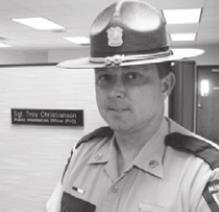
If you have any questions concerning traffic related laws or issues in Minnesota send your questions to Sgt. Troy Christianson – Minnesota State Patrol at 2900 48th Street NW, Rochester MN 55901-5848. (Or reach him at, Troy.Christianson@state.mn.us)
Question: My wife slid off the state highway this morning. She came to a stop in the median ditch, unhurt but rattled - only needing to be pulled out. When she called me I told her to call the State Patrol and stay in the car until you arrived. What is the right procedure to follow when a driver ends up stuck in the ditch? Do you contact the towing company or is that the responsibility of the stuck driver?
Answer: First of all, I am glad she is all right. Secondly, thank you for the email as this is a great topic. Minnesota State Troopers have responded to approximately 6,916 vehicles that have slid off the highway in 2021 and needed assistance. This does not include crashes, motorist assists and other calls for service.
If you slide off the highway, the first thing a person should do is assess the situation.
• Is anyone injured? If so, call “911” immediately.
• Are you in a safe or dangerous location? Generally, it is best to stay in your vehicle as it will offer you some protection.
• Is your vehicle partially on the highway in the traffic lane? Are you on the bad side of a hill or curve? If so, you and your occupants might be safer leaving the vehicle. However, do not stand on the highway. Find a location that is safe and far off the highway.
After it is safe and reasonable, please report the incident as soon as possible. Be prepared to give your location and a brief description of what happened.
If you are stuck in snow, mud or for whatever reason, you can call a tow truck or ask the dispatcher to have them send one. If you do call a tow, tell the appropriate law enforcement agency (State Patrol/Sheriff/ Police) to help prevent doubling up and keeping responding resources available for others.
State Troopers and other law enforcement agencies will help with traffic control and provide scene safety as the tow truck operators go to work. Even for a vehicle breakdown or flat tire, call in and we will do our best to respond and help keep everyone safe.